Skibbereen – Irish Famine Ballad of Loss, Exile & Eviction
You'll find versions of "Skibbereen" sung in kitchens, pubs and concert halls right across the Irish diaspora. Here's why it travels so well.
Opening
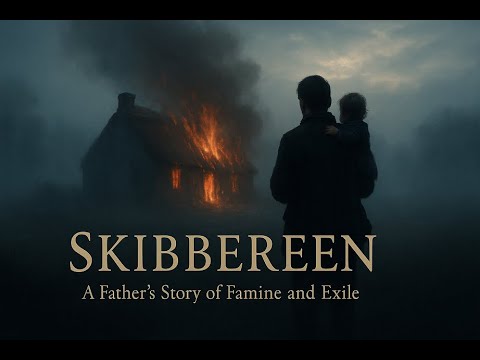
There’s a moment in “Skibbereen” that always lands like a stone dropped in still water: “They set the roof on fire with their cursed English spleen.” It’s not poetic prettiness. It’s the blunt memory of a family watching their home go up, the kind of detail you don’t invent because it’s too cruel to be decorative.
The song is framed as a conversation between a son and his father, but it feels like something overheard — a story told low at the hearth, the sort that starts with a child’s innocent question and ends with a vow that can’t quite heal what’s been broken. “Then, why did you abandon it?” the son asks, and the father answers with the kind of reasons that don’t fit neatly into a history book.
History & Origins
“Skibbereen” (often sung as “Dear Old Skibbereen”) is tied to West Cork and to the Great Famine, but like many ballads carried more by mouths than manuscripts, its exact beginnings are hard to pin down. It likely took shape in the decades after the worst of the hunger, when survivors and emigrants were trying to make sense of what had happened — and when songs were one of the few ways ordinary people could set down a record that felt true to their lives.
Some versions lean heavily into Famine eviction and flight; others sharpen the political edge by bringing in the year of ’48, the Young Ireland rising. That mix is part of the ballad’s power. Irish songs often don’t separate “personal tragedy” from “public history” the way modern commentary does. In the singing tradition, the death of a mother in the snow and the hunt for a rebel in the mountains belong in the same breath, because that’s how it was lived.
In terms of popularity, “Skibbereen” has been a mainstay in the ballad repertoire for generations — the kind of song that turns up wherever Irish people gather to sing, whether that’s in Cork, in London, in Boston, or in a kitchen half a world away. It’s also been printed in various songbooks and collections over the years, though you’ll notice small shifts in wording from singer to singer. That’s not sloppiness; that’s the oral tradition doing what it does, keeping the spine of the story while letting the language suit the voice carrying it.
Meaning & Themes
The first verse sets the emotional trap beautifully. The son has grown up hearing about “Erin’s isle,” about “valleys green” and “mountains rude and wild,” a place “wherein a prince might dwell.” It’s the Ireland of memory and longing — the Ireland emigrants describe when they’re trying to give their children something to hold onto. And then the boy asks the question every child of exile eventually asks: if it was so lovely, why did we leave?
The father’s answer starts with pride — “I loved my native land with energy and pride” — and then the blight arrives like a sentence. “’Til a blight came over all my crops and my sheep and cattle died.” In a few plain lines, the song captures the awful chain that followed: hunger, loss of livelihood, and then the machinery of rent and taxation grinding on anyway. “The rents and taxes were to pay, and I could not them redeem.” That word redeem is doing a lot of work. It’s not just that he couldn’t pay; it’s that there was no saving himself within the system he was trapped in.
Then comes the eviction scene, and the song doesn’t flinch. “The bailiff and the landlord came to drive us all away,” and the roof is set on fire — not metaphorically, but as a tactic. In many Famine-era evictions, roofs were indeed “tumbled” or homes were made uninhabitable to prevent people returning. The ballad’s anger is pointed, naming “their cursed English spleen,” and whether a singer chooses to bite down hard on that line or let it fall with weary disgust, it’s always a moment that changes the room.
The most devastating verse, for my money, is the one about the mother: “lay on the snowy ground… She never rose but passed away from life to immortal dreams.” There’s no grand sermon here, just the image of a woman collapsing amid “desolation ’round.” It’s grief without ornament, and it’s also a reminder that famine wasn’t only starvation; it was exposure, sickness, exhaustion, and the slow breaking of people who’d already been pushed past endurance.
And then the song widens again into politics. “It’s well I do remember the year of ’forty‑eight,” the father says, when “we arose with Erin’s boys to fight against our fate.” That verse links private catastrophe to national resistance, and it also explains another kind of exile: “I was hunted through the mountains, as traitor to the Queen.” In a few lines, he becomes not only a victim of eviction but a man marked by rebellion. Even the tenderness of the escape — wrapping the child in a “Cóta mór” and slipping away “in the dead of the night unseen” — carries the weight of pursuit.
The final verse belongs to the son, and it’s a jolt. After listening to hunger, eviction, and death, he answers with vengeance: “the day will come when in vengeance we will call… ‘Revenge for Skibbereen!’” Some singers deliver it like a rallying cry; others sing it with a hint of tragedy, as if the father knows what that road costs too. Either way, the song refuses to end on quiet sorrow. It ends with a promise — and with the complicated inheritance handed from one generation to the next.
Legacy & Significance
“Skibbereen” still matters because it tells the Famine story in human scale: a father, a mother, a child, a burning roof, a coat pulled tight around small shoulders. It’s history you can feel in your chest. And when you hear it in a session, it often changes the pace of the night — people listen differently, even if they’ve heard it a hundred times.
It’s also a reminder of how ballads function as community memory. Long before most families had written records, songs like this carried names, places, and accusations. If you’re browsing Irish Folk Music looking for the stories behind the songs, “Skibbereen” is one of those pieces that shows why the tradition endures: not because it’s quaint, but because it tells the truth in a way that sticks.
Listen & Watch More
If you want to stay with this mood for a while, you’ll find more songs and sessions over on Irish Pub Songs on YouTube. For playlists you can throw on while you’re cooking or driving, follow along on Traditional Irish Music on Spotify and Buy Traditional Irish Music on Apple Music. And if you’d like to go straight back to this performance, here’s the link to Watch "Skibbereen" on YouTube.
For more like this, browse the rest of Virtual Magic Music.
Keep the music going with our Live Traditional Irish Music — always on, always Irish.


Comments
Post a Comment